Consumers seeking healthier indoor environments now have a wide range of air quality testing equipment. This guide highlights reliable kits and monitors that measure pollutants, humidity, and other indicators to help you understand and improve indoor air. The selections include mold testing kits for DIY detection and multi-parameter air quality monitors for real-time readings and alerts. Each option below is designed for American homes and offices, with clear data to support informed decisions about ventilation, filtration, and remediation.
Summary of Selected Products
- Kayenqo Mold Test Kit — 12 tests for indoor air, surfaces, HVAC, and more
- YNAK 16-in-1 Indoor Air Quality Monitor — real-time 9 parameters with alerts
- bonoch 16-in-1 Indoor Air Quality Monitor — precision sensors and 7 alerts
- Flazecon Air Quality Monitor — 5-in-1 real-time monitor with audible alarms
- Rozoroo 12-in-1 Indoor Air Quality Monitor — comprehensive sensor suite with CO2 alarm
Kayenqo 12-Detection Mold Kit for Home

The Kayenqo Mold Test Kit provides 12 test plates and a detailed mold guide for at-home detection. Included are swabs, label sheets, test gloves, and a complete kit for testing indoor air, HVAC systems, and surfaces. It covers a range of common household molds and allows testing across multiple areas or two tests on six spaces. If mold thresholds are exceeded, the kit includes a removal guide and instructions for retesting after remediation.
Features support DIY mold screening across walls, showers, cars, sinks, HVAC components, and other moist surfaces. The kit’s 12 independent plates enable multiple samples, helping identify problem spots in homes or offices. While not a substitute for professional assessment in complex cases, it provides actionable guidance for initial sanitation and remediation steps.
This option is best for homeowners who want a proactive approach to mold awareness and who prefer immediate, at-home sampling without special equipment. Safe disposal and proper handling of samples are advised. Regular retesting after cleanup can help verify that mold levels have dropped.
YNAK 16-in-1 Indoor Air Quality Monitor

This 16-in-1 monitor tracks nine key parameters in real time, including CO2, PM2.5, PM1.0, PM10, HCHO (formaldehyde), TVOC, temperature, humidity, and AQI. It additionally includes time and multiple alert buzzers to inform you about changing air conditions. External high-precision sensors claim to deliver accurate readings with minimal lag, enhancing confidence in the data you rely on for comfort and safety.
The device emphasizes direct sampling and a straightforward display, with a note to avoid touching sensors or exposing them to perfumes to maintain accuracy. Real-time alerts help families respond quickly to poor air quality, especially in spaces with limited ventilation or new materials emitting gases. A mute option provides flexibility when alarms are not needed.
Ideal for living spaces, offices, and classrooms, this monitor supports proactive decisions around filtration and ventilation. The inclusion of an external sensor array helps maintain precision as environmental conditions shift, making it a strong choice for users who value rapid, dependable feedback.
bonoch 16-in-1 Indoor Air Quality Monitor

The bonoch AirSentry monitor offers 16-in-1 functionality, measuring CO2, PM2.5/PM1.0/PM10, HCHO, TVOC, temperature, humidity, and AQI with seven customizable alert alarms. It uses external high-precision sensors for 0.001-level accuracy and a multi-sensor array to detect subtle changes in air quality. The device includes a clear display and a mute button to manage alert noise.
Its emphasis on exceeding performance benchmarks and providing instant, actionable alerts makes it suitable for homes prioritizing clean air, especially where occupants may have sensitivities to allergens or chemical emissions. The sensor design supports ongoing maintenance and reduces the need for frequent recalibration, depending on usage and environment.
As a home or small-office monitoring tool, this unit helps you monitor pollutants in real time while guiding decisions about ventilation and filtration to maintain comfortable indoor conditions.
Flazecon Air Quality Monitor — 5-in-1
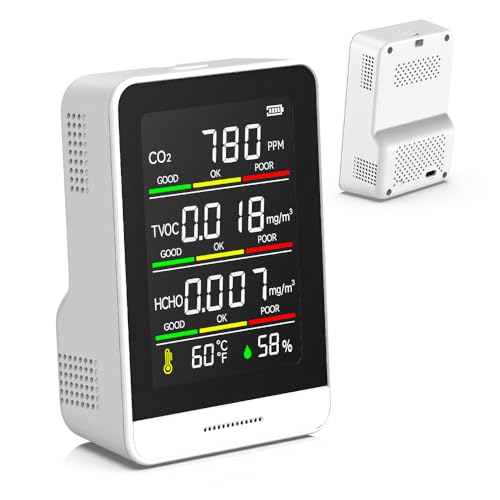
The Flazecon 5-in-1 indoor air quality monitor tracks CO2, HCHO (formaldehyde), TVOC, temperature, and humidity in real time. It features a high-precision sensor with a dual-ventilation structure, delivering rapid and stable feedback. The device uses a bright, color-coded display for quick interpretation and provides a real-time audible alarm when pollutant levels exceed preset limits. A visual alert complements the audible cue to help occupants respond quickly.
Designed for homes, offices, hotels, and cars, this monitor emphasizes easy readability and prompt notifications. It is well-suited for ongoing monitoring in spaces with fluctuating occupancy or renovation activities that may temporarily raise pollutant levels.
Rozoroo 12-in-1 Indoor Air Quality Monitor

The Rozoroo monitor provides a 12-in-1 sensor array, delivering data for CO2, TVOC, HCHO, PM1.0, PM2.5, PM10, AQI, humidity, temperature, time, and a CO2 alarm. Its large, color-rich display helps users quickly interpret air quality, with a dedicated CO2 alert to signal potential ventilation concerns. The device emphasizes real-time monitoring and a balanced set of measurements suitable for homes, offices, and travel setups.
This unit is appropriate for users who want a broad spectrum of air quality data in a single device. The CO2 alarm and AQI indicators support proactive adjustment of ventilation and filtration strategies, making it a solid all-around option for maintaining healthier indoor environments.
Buying Guide: Key Considerations for Air Quality Equipment
- Purpose and scope: Mold-focused kits are ideal for remediation planning, while multi-parameter monitors support ongoing surveillance of indoor air quality. Match the device to your needs—spot checks vs. continuous monitoring.
- Number of metrics: Consider how many pollutants you want tracked (CO2, PM2.5, HCHO, TVOC, PM10, etc.). More metrics provide deeper insight but may require more interpretation.
- Sensor quality: Look for devices with external high-precision sensors, stable calibration, and documented accuracy. Replaceable sensors can extend device life for PM sensors.
- Alerts and alarms: Real-time alerts help you respond quickly. Check the alarm categories (audible, visual, or both) and whether you can customize thresholds.
- Display and readability: A clear, color-coded display aids quick interpretation. Large screens with intuitive icons are preferable for fast assessments.
- Ease of use: DIY kits should come with clear instructions, while monitors should have user-friendly interfaces and straightforward data access.
- Maintenance: Consider power options, battery life, and sensor replacement requirements. Some devices require occasional recalibration or sensor replacement.
- Data access: Some devices offer data export or smartphone app integration for trend analysis and historical records. Assess connectivity needs.
- Cost of ownership: Beyond the initial purchase, factor in test consumables, replacement parts, and potential professional testing if thresholds are exceeded.
- Use case scenarios: For new construction or renovations, prioritize VOC and formaldehyde tracking. For damp environments, emphasize mold testing and humidity monitoring.
When selecting air quality equipment, weigh the balance between mold testing capabilities and continuous environmental monitoring. For households with sensitivities, combining a mold test kit with a reliable multi-parameter monitor offers comprehensive insight. For offices or schools, continuous monitoring with real-time alerts can support safer occupancy and better ventilation management.