Answering the search for reliable 36-inch baseboard heaters, this guide highlights five solid options suited for different homes and needs. It targets buyers seeking straightforward installation, steady convection warmth, and compatibility with common voltages. Best fits include corded units for retrofit projects, models with built-in thermostats, and affordable options for US rooms. The comparison table below summarizes key details to help you compare at a glance.
| Product | Brand | Voltage | Wattage | BTU | Best For |
|---|---|---|---|---|---|
| Cadet F Series 36″ (3F750W, 09952) | Cadet | 240/208 | 750/563 | 2560/1925 | Homes needing higher heat output on 240V |
| Cadet F Series 36″ (3F750-1W, 05532) | Cadet | 120 | 750 | 2560 | Retrofits on standard 120V circuits |
| Dayton 36″ Electric Baseboard Heater | Dayton | 120 | 750 | — | Budget-friendly 120V option |
| Dimplex 35″ Proportional Linear Convector (PC3512W31) | DIMPLEX | 240/208 | 1250/938 | — | Smart heat control with learning technology |
| King 3K1207BW 750W 3-Foot Baseboard Heater | KING | 120 | 750 | — | Compact 3-foot option for tight spaces |
Cadet F Series 36″ Electric Baseboard Heater (3F750W, 09952)
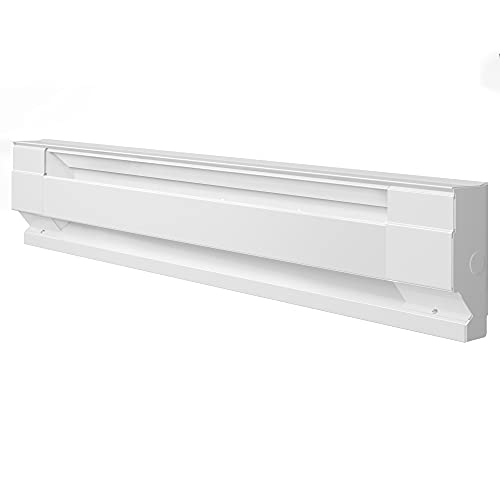
The Cadet 3F750W 36″ model is a versatile, high-output heater with multi-watt capabilities (750/563 Watts) and both 240/208-volt options. It uses universal wiring and has pre-punched knockouts to simplify installation. The convection design helps circulate warm air for uniform room heating. Best for larger rooms or spaces that run on 240V circuits, where higher BTU output is desirable. A potential limitation is needing appropriate wiring for 240V installations.
Cadet F Series 36″ Electric Baseboard Heater (3F750-1W, 05532)
This 36-inch Cadet unit runs at 750 Watts on a standard 120-volt circuit. It’s a robust choice for rooms that rely on a single, simple heat source and where thermostat control is required. It is all-metal with a powder-coated finish and requires a compatible thermostat for best results. Choose this if you need a straightforward 120V solution without higher-voltage wiring.
Dayton 36″ Electric Baseboard Heater

The Dayton 36″ baseboard heater offers a cost-effective 750W, 120V option. It’s built to be a practical replacement in spaces needing reliable, quiet heat. This model may be best for budget-conscious projects or rooms with existing 120V wiring where no special voltages are required. The simplicity can be a strength, though heat output is tied to a common 120V supply.
Dimplex 35″ Proportional Linear Convector Baseboard Heater (PC3512W31)

The Dimplex PC3512W31 includes built-in learning technology to adapt to room conditions and maintain comfort efficiently. It is a 240V/208V model with higher wattage (1250/938W), which translates to substantial BTU output for larger spaces or rooms that demand precise temperature control. It also supports an onboard thermostat and transceiver for integration with advanced wireless systems. Best for smart-heat setups, but ensure your wiring and thermostat plans accommodate its higher capacity.
King 3K1207BW 750-Watt 120-Volt Baseboard Heater

The King 3K1207BW provides a compact 3-foot baseboard heater at 750W on a 120V circuit. Its aluminum ribbon fin element and full-length safety cutout aim to deliver reliable warmth with a straightforward installation. This option is well-suited for smaller rooms or spaces where a shorter unit fits better. A limitation is that its heat capacity may be less than larger 36-inch panels in bigger rooms.
Buying Guide
What should you consider when choosing a 36-inch baseboard heater?
- Voltage and wiring: Choose 120V for standard circuits or 240V/208V for higher heat output. Ensure your electrical panel and wiring can support the unit.
- Wattage and BTU needs: Higher wattage increases heat output. For larger rooms, consider 1000+ BTU per hour targets, while smaller spaces can use lower wattage.
- Thermostat features: Built-in thermostats simplify control; some units integrate with wireless systems for smarter temperature management.
- Installation ease: Look for models with pre-punched knockouts and universal wiring to reduce installation time.
- Safety and durability: All-metal construction and protective features improve longevity; consider rust-proof finishes for damp areas.
Frequently Asked Questions
- What size baseboard heater should I choose for a medium-sized room?
– For a typical living room around 150-200 square feet, a 750W 120V or a higher-output model on 240V can provide comfortable warmth, depending on insulation and climate. - Do I need a thermostat with a baseboard heater?
– A thermostat helps regulate temperature and can improve energy efficiency. Some models include onboard thermostats; others require an external thermostat. - Is a 36-inch heater enough for large rooms?
– In larger rooms, you may need multiple units or a higher-w output model (often 1000W or more) to reach target comfort levels. - Can these heaters be installed in damp areas?
– Many are designed for dry interiors; verify the specific model’s suitability for moisture-prone spaces before installation. - Are 120V and 240V units interchangeable?
– They are not interchangeable. Choose the voltage based on existing wiring, electrical panel capacity, and the desired heat output. - What maintenance is required?
– Baseboard heaters generally require minimal maintenance beyond occasional dusting and ensuring vents remain unobstructed for proper airflow.