Answering the need for pure, stable water in reef, freshwater, and planted tanks, these reverse osmosis (RO) and RO/DI filtration systems remove common tap-water contaminants. They’re best suited for aquarists who want consistent water quality, lower maintenance, and reliable filtration for sensitive fish and invertebrates. This guide highlights five top options, explains who each is best for, and compares key features to help you choose the right unit for your aquarium setup. A quick summary table follows to simplify product comparison at a glance.
| Product | Best For | Key Benefit | Approx. Output |
|---|---|---|---|
| Aquatic Life RO Buddie 4-Stage | Small to mid-size tanks | Compact RO/DI for clean water | Up to 50 GPD |
| Aquatic Life Twist-In 4-Stage | Versatile tank setups | DI resin color-change indicator | Up to 75 GPD |
| Geekpure 4 Stage Portable | RVs, apartments, temporary setups | Portable RO/DI with DI stage | Up to 100 GPD |
| iSpring RCC1DP Tankless 5 Stage | High-demand or lab-style uses | Tankless design with strong pump | Up to 150 GPD |
| Aquatic Life 4-Stage 100 GPD RO/DI | Mid-to-large tanks | Carbon Plus cartridge reduces chloramines | 100 GPD |
Aquatic Life RO Buddie 4-Stage RO/DI System
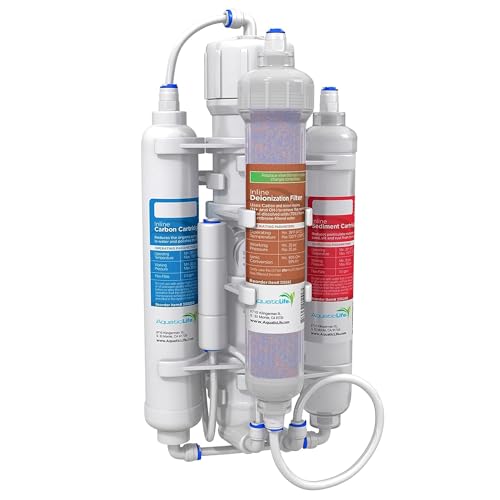
The Aquatic Life RO Buddie 4-Stage filters tap water through a sediment filter, carbon block, RO membrane, and DI resin to produce cleaner water for aquariums, humidifiers, and fountains. It’s best for small-to-mid-size tanks where space is a factor and users want reliable RO water with straightforward cartridge changes.
Best for: hobbyists with compact setups and a need for simple, steady filtration. The unit’s sediment and carbon stages help reduce particulates and odors, while the DI resin finishes the purification. A potential limitation is the note that chloramines aren’t removed by this system, so you may need a separate chloramine treatment for chloramine-heavy municipal supplies.
Aquatic Life Twist-In 4-Stage RO/DI System
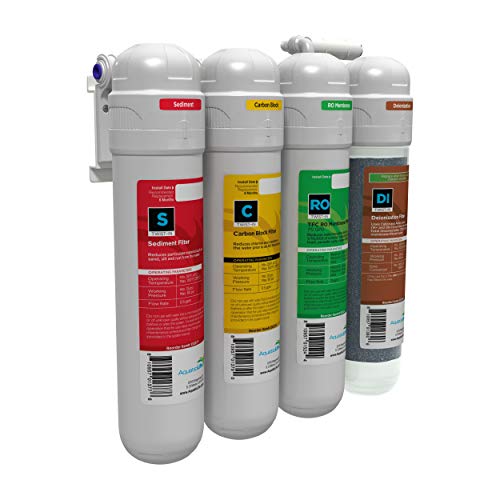
This Twist-In 4-Stage model combines sediment, carbon, RO membrane, and DI resin with a color-changing DI stage. It yields up to 75 GPD and removes a broad range of dissolved solids to create water gentler on sensitive aquatic life. It does not remove chloramines, so plan accordingly if your source water contains them.
Best for: aquarists seeking a complete RO/DI setup with a visible DI resin life indicator and robust filtration. Choose this if you want a compact, easy-to-service system with flexible DI resin replacement. Limitation: chloramines are not removed, necessitating alternative treatment for some municipalities.
Geekpure 4 Stage Portable RO System

Geekpure’s portable 4-stage unit is designed for flexible use—ideal for apartments, RVs, boats, or travel. It features a multi-stage filtration process with a sediment filter, carbon block, RO membrane, and a mixed-bed DI filter to achieve near-zero TDS. It’s NSF/ANSI-compliant components and quick-connect fittings support easy maintenance and reliable water quality.
Best for: users needing a mobile or space-efficient RO/DI solution that still delivers highly purified water. Better for: temporary or irregular-use scenarios. Caution: as a portable model, it may require more hands-on setup and monitoring compared with stationary systems.
iSpring RCC1DP Tankless 5-Stage RO/DI System

The iSpring RCC1DP uses a tankless design with a pump to maintain filtration performance in low-pressure environments. It delivers up to 150 GPD and aims at high-demand uses, from active aquariums to labs. The system targets a broad pollutant range, including chlorine, fluoride, and lead, with the DI stage helping drive TDS toward very low levels.
Best for: aquarists needing strong output and consistent flow, especially when water pressure is a concern. Choose this if you require rapid filtration and minimal storage footprint. Limitation: claims about removing certain contaminants should be verified against your local water report and system setup.
Aquatic Life 4-Stage RO/DI Filtration with Carbon Plus
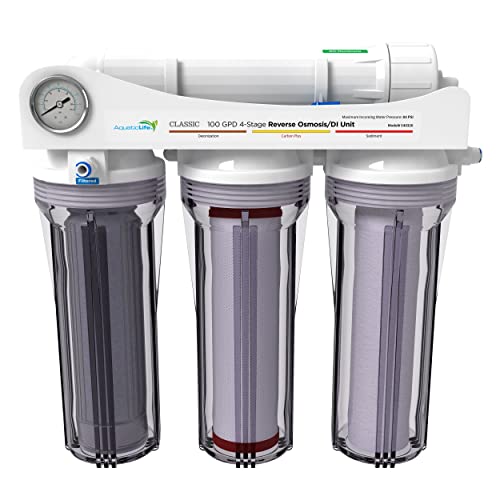
This 4-stage unit provides 100 GPD of filtered RO water and includes a carbon-plus cartridge designed to remove up to 98% of chloramines and 99% of chlorine. Its comprehensive filtration suits mid-to-large aquariums, ensuring water is safe for a variety of fish and plants. DI resin offers extra purification for ultra-pure output.
Best for: aquarists needing strong chloramine/chlorine reduction and higher daily output. Better for: systems with chloramine-treated municipal water. Caution: ensure compatibility with your tank’s need for 0–low TDS water after DI for sensitive species.
Buying Guide
What size aquarium are you filtering for?
Smaller tanks (<50 gallons) often pair well with compact RO Buddie-style units. Larger displays benefit from higher GPD capacities like 100–150 GPD systems to keep up with water changes and topping off.
Do you need RO or RO/DI?
RO removes many dissolved solids; RO/DI adds a deionization stage for near-zero TDS water. If your source water has heavy chloramines or you keep highly sensitive species, RO/DI is typically preferable.
Is chloramine removal required?
Not all systems remove chloramines. If your municipality uses chloramines, consider a system with a Chloramine-ready filtration or plan an additional treatment stage.
How important is portability or installation space?
Apartment dwellers or travelers may favor portable units with fewer installation requirements. Stationary systems suit dedicated fish rooms where space is available and maintenance can be scheduled regularly.
Maintenance and replacement considerations
Look for color-changing DI resins, easily accessible cartridges, and clear service indicators. Keeping filter components topped up and replacing DI resin helps sustain water purity and system efficiency.
Which system matches your budget and water quality goals?
Balance capital cost with daily output and desired water quality. For beginners, a simple 3–4 stage setup may suffice; advanced aquarists often choose multi-stage RO/DI with DI resin and carbon upgrades for optimal water quality.
FAQ
- What does GPD mean? Gallons Per Day; it indicates the system’s production capacity under typical conditions.
- Can these systems remove all contaminants? They remove many dissolved solids and chlorine/odor compounds, but some systems do not remove chloramines unless specified.
- Do I need a storage tank? Some units are tankless or portable, while others use a storage reservoir. Your setup determines practicality and space needs.
- How often should filters be replaced? Replacement frequency depends on water quality and usage; DI resin and RO membranes typically require periodic checks and replacements per manufacturer guidance.
- Can these systems affect fish health? Yes, higher purity water with stable TDS levels supports healthier aquatic environments, particularly for sensitive species.
- Are these units easy to install? Most include standard fittings and push-to-connect tubing, but follow the manufacturer’s instructions for drainage, feed water supply, and membrane orientation.