Answer: Acoustic foam panels are a practical option for reducing echoes, flutter echoes, and reverberation in home studios, offices, theaters, and living rooms. This guide highlights five top foam panels that balance absorption performance with easy installation. Whether you’re recording vocals, gaming, or simply wanting quieter workspaces, these picks are chosen for room size, density, and ease of use. The buyer-friendly sections explain who benefits most, with concise pros, limitations, and installation notes.
Summary table of selected products
| Product | Brand | Best For | |
|---|---|---|---|
| Focusound 52 Pack Acoustic Foam Panels | Focusound | ||
| Saiqiang Acoustic Foam Panels Sound Absorbing 12 Pack | Saiqiang | ||
| 12 Pack Sound Proof Foam Panels for Walls | TANLIJUN | ||
| 12 Pack Pyramid Sound Proof Foam Panels | ZonaSonic | ||
| DynaPad Four-Layer Composite Foam Roll | Dynamat |
Focusound 52 Pack Acoustic Foam Panels

Best for expansive coverage in home studios or multi-purpose rooms. These triangular-groove panels are designed to absorb reflections, reduce reverb, and lower flutter echoes for a clearer sound capture. The high-density foam supports quicker, more consistent absorption, making it suitable for vocal booths, small studios, or control rooms. The included 300 double-sided adhesive tapes facilitate quick installation and wall protection. A noted limitation is that larger rooms may require more panels to reach ideal absorption, and surface preparation is key for adhesive performance.
Saiqiang Acoustic Foam Panels Sound Absorbing 12 Pack
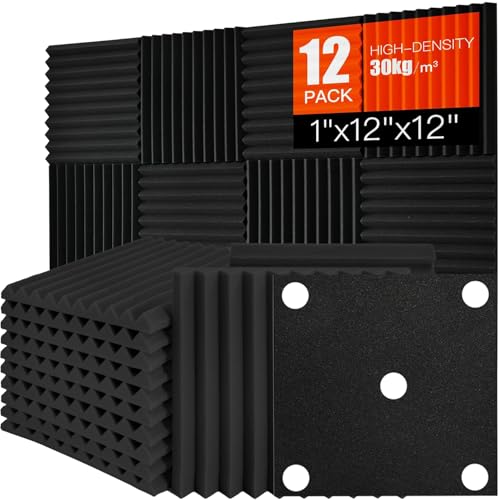
Best for studios, podcasts, and home theaters that demand strong reflection control and fire-safety compliance. The high-density foam is designed to manage both high and low-frequency reflections, helping create a balanced listening environment. It is promoted as fire-resistant and non-toxic, which can be important in longer listening sessions or enclosed spaces. Best for spaces where safer materials are preferred and where sound clarity is a priority. A potential limitation is the size and density may be excessive for very small rooms, needing careful placement planning.
12 Pack Sound Proof Foam Panels for Walls (TANLIJUN)

Best for flexible room layouts and easy DIY installation. Each panel includes self-adhesive pads, enabling quick mounting on clean, smooth walls without extra glue. The wedge texture supports modular design, letting you create varied patterns to optimize coverage and absorption. If walls are textured or uneven, adhesion may be less reliable, so surface prep helps. Also, rapid reshaping is highlighted as a recovery feature after deformation, with restoration typically within 24–48 hours.
12 Pack Pyramid Sound Proof Foam Panels (ZonaSonic)

Best for gaming studios and broadcasting rooms that benefit from dense absorption and strong adhesive performance. The pyramid texture, combined with a high-density material, aims to reduce both echoes and reverberations across a wide frequency range. The upgraded double-sided adhesive improves wall attachment, helping panels stay in place in active spaces. A limitation is that very large wall areas may require multiple packs for thorough coverage, which should be planned before installation.
DynaPad Four-Layer Composite Sound Dampening Foam (Dynamat)

Best for floor-level sound dampening and cross-room noise control in spaces with elevated footfall or equipment noise. DynaPad provides a four-layer composite approach that targets floor transmission, which can significantly lessen impact noise and airborne sound travel through floors. It offers a substantial insulation area per roll (54″ x 25 ft). A limitation is that it is a roll-based product, requiring careful cutting and fitting on uneven floor layouts or irregular rooms.
Buying Guide: Key Purchase Considerations
What room size and use should guide your choice?
Smaller rooms benefit from higher density panels with careful placement to avoid over-absorption. Larger rooms require broader coverage and a mix of panel shapes (flat vs. pyramid) to manage a wider range of frequencies.
How important is adhesion and wall prep?
Adhesive quality and wall type matter. Self-adhesive pads or tapes work well on smooth surfaces, while textured walls may need prep or alternative mounting methods. If you expect frequent rearrangements, consider panels with repositionable adhesives or magnetic frames.
What frequency range should panels target?
For vocal recording and spoken word, mid-to-high frequency absorption is often most beneficial. For music production or home theaters, include panels with broader frequency coverage to tame bass buildup and low-end reflections.
Do you need fire-safety or eco considerations?
Some products claim fire-resistance or non-toxicity. If this is important for a child’s room, a home theater, or shared living spaces, prioritize those options and confirm material certifications where available.
Installation and future flexibility
Panels with self-adhesive options support quick installs and redeployments. Products bundled with extra tapes or pads can simplify initial setup, but be prepared to patch any adhesive residue when removing panels.
Coverage strategy and layout planning
Plan a layout that targets early reflections first: walls near listening positions, rear walls, and ceiling areas where reflections are strongest. Use a mix of wedge and pyramid shapes to address a wider spectrum of sounds.
FAQs
- What is the main purpose of acoustic foam panels? They reduce echoes and reverberation, improving sound clarity without fully sealing a space.
- Can I install panels myself without tools? Yes, many panels come with self-adhesive pads or tapes for easy DIY installation on smooth walls.
- Will panels affect cheap or loud sources differently? Higher-density panels tend to absorb a broader frequency range, benefiting both loud sources and quieter, detailed recordings.
- How do I know how many panels I need? Start with listening tests in your room, then estimate coverage by room area and target reflection zones. More coverage improves absorption but may require more planning.
- Are there safety concerns with foam panels? Look for non-toxic materials and fire-resistance claims if this is a priority for your space.
- Can foam panels replace full soundproofing? Acoustic foam reduces reflections and echoes but does not fully block external noise or create a soundproof room. For complete isolation, consider additional barriers or mass-loaded barriers.