Ground-mounted solar structures offer durable, scalable mounting solutions for large installations on farms, sheds, and open land. This guide reviews five top options that balance stability, ease of installation, and sun exposure optimization. Each product is evaluated on adaptability, durability, and tilt capabilities to help you choose a system that fits your site and energy goals.
Summary of selected products:
- ECO-WORTHY Solar Ground Mount Adjustable Bracket System (Large 5x400W arrays)
- ECO-WORTHY Upgraded Ground Mount Brackets Kit (4x200W to 4x400W ranges)
- Solar Panel Array Top of Pole Ground Mount Bracket (2″ – 3″ pipes)
- EUIJOIP Adjustable Ground Mount Brackets (16″ tilt-ready)
- Xmntdo Adjustable Tilt Mounts (50W-400W panels)
ECO-WORTHY Solar Ground Mount Adjustable Bracket System
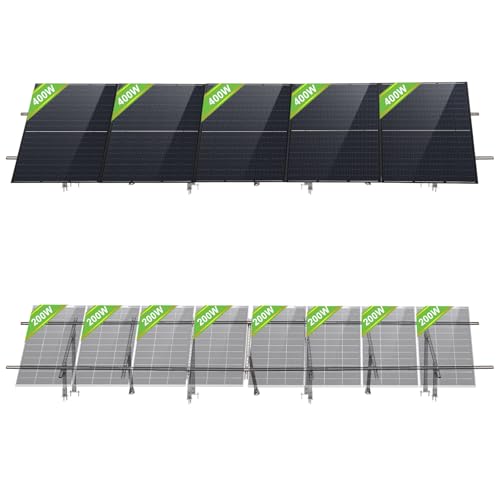
The ECO-WORTHY system emphasizes strong adaptability for larger installations. Dimensions provided indicate a substantial footprint to support up to five 400W panels, with tall front and rear pillars designed to handle heavy loads. The design supports homes, farms, cabins, and off-grid sites, bringing flexibility to expanding solar capacity in open areas.
Stability is a core feature: a multi-triangular structure, reinforced by three middle support rods and cement-based bases, aims to prevent sagging and maintain panel alignment. The bracket is stated to bear around 330 pounds without denting, which makes it suitable for long-term outdoor exposure and high-wind environments. Installers should ensure correct spacing and base anchoring according to the recommended 59 inches between vertical columns for best performance.
Efficiency improvements are highlighted through adjustable mounting angles. Seven preset angles ranging from 30° to 60° enable alignment with seasonal sun paths, maximizing energy capture. This flexibility helps maintain strong performance across different latitudes and times of year while keeping installation options broad for large-scale sites.
ECO-WORTHY Upgraded Ground Mount Brackets Kit System

This kit targets bigger installations with a slightly different footprint option. The front and rear pillars measure 5.9 inches higher, with front and rear column heights designed to support large solar panels more securely. The recommended spacing between vertical columns remains 59 inches, and a mid-span support rod is advised to minimize mid-panel sag and improve overall stability. The kit is suitable for home and off-grid scenarios alike, including cabins and farms that demand reliable performance under various conditions.
Load bearing and stability are emphasized, with a claimed capacity up to 160 pounds for each mount area. This helps address concerns about mid-span bending on longer panel rows, ensuring a robust mounting solution for extended arrays. The 30–60 degree adjustable tilt enables sun optimization across seasons, contributing to higher annual energy production for larger systems.
For effective deployment, consider combining these brackets with a solid foundation and careful alignment to ensure the full array benefits from the adjustable tilt. The design supports a flexible range of panel sizes, catering to multi-panel configurations needed at larger sites.
Solar Panel Array Top of Pole Ground Mount Bracket

This option targets vertical or pole-supported ground arrays, offering compatibility with 2″ to 3″ pipe sizes. It supports a mix of large (400W) and mid-range panels, making it versatile for varying installation layouts on open land or along fences and borders. The mounting approach emphasizes adjustable angle and tilt, enabling precise sun tracking to optimize energy capture throughout the day and across seasonal cycles.
Value is placed on modularity: you can configure 1–3 large panels or several smaller panels in a row using different pole configurations. While only a bracket is included in the listing, it’s compatible with related mounting kits that provide struts and clamps, offering a cohesive path from single-panel setups to more complex ground-mounted arrays.
Designed for straightforward installation, this bracket provides a reliable method for mounting panels to existing poles or new ground poles. The emphasis on easy tilt adjustments makes it a practical choice for users who want responsive sun-angle control without extensive structural changes.
EUIJOIP Solar Panel Mounts With Foldable Tilt Legs

The EUIJOIP brackets focus on portability and higher adaptability for smaller, portable solar arrays suitable for RVs, boats, and off-grid sheds. The tilt mechanism allows a wide range from 0 to 90 degrees, enabling optimal sun exposure regardless of season. This flexibility is particularly valuable for users who need to relocate or reorient panels seasonally or seasonally changing conditions.
Compatibility with 16-inch wide panels makes this kit appropriate for compact ground setups and off-grid configurations where space is at a premium. The design supports efficient energy capture by facilitating precise tilt, contributing to improved performance for portable and semi-permanent solar installations associated with recreational or rural uses.
As with other adjustable systems, ensure solid anchoring and weatherproofing to sustain long-term performance. The kit’s foldable tilt legs simplify storage and transport, making it a practical option for users who frequently reconfigure their solar layout or travel with a mobile system.
Xmntdo Solar Panel Tilt Mount Brackets

The Xmntdo mounting system is built for multiple wattage ranges, from 50W to 400W panels, with a focus on ground, roof, and vehicle integration. It offers a 15–30 degree tilt to optimize solar capture and supports easy installation with aluminum alloy components known for durability and weather resistance. The modular nature makes it suitable for expanding existing ground installations or creating new ones in open spaces.
With robust corrosion resistance and a straightforward bolt-on design, this bracket set suits long-term outdoor use. The emphasis on adjustable tilt supports seasonal optimization, particularly for sites that prioritize annual energy output. It’s a versatile choice for homeowners who envision evolving the array over time as energy needs grow.
Buying Guide: Key Considerations For Ground Mounted Solar Structures
When choosing a ground-mounted solar structure, consider the following factors to ensure a reliable, efficient, and cost-effective installation.
- Site conditions and soil: Evaluate soil type, drainage, wind exposure, and potential snow loads. Stabilized bases and proper anchoring are essential for long-term performance in open areas.
- Panel size and quantity: Choose mounting systems that accommodate the planned panel wattage, dimensions, and the number of modules. Larger systems benefit from sturdier frames and reinforced bases.
- Adjustability and tilt options: Tilt capability improves energy capture. Consider latitude, seasonal sun angle, and the ease of adjusting tilt over the system’s life.
- Durability and materials: Aluminum and galvanized steel provide corrosion resistance and longevity. Look for weatherproof fasteners and robust joint connections.
- Ease of installation and maintenance: Systems with clear mounting instructions, modular components, and accessible add-ons reduce installation time and maintenance costs.
- Expansion plans: If you anticipate growth, select brackets that support future panel additions and align with common mounting standards to avoid compatibility issues.
- Local regulations and permits: Check HOA guidelines, environmental rules, and electrical code requirements for ground-mounted installations in your area.
In summary, the best ground-mounted solar structures balance stability, adaptability, and tilt control. For large-scale sites such as farms or sheds, prioritize robust bases and high load ratings. For portable or semi-permanent setups, lean toward adjustable, modular brackets that simplify relocation and seasonal sun optimization. Always ensure compatibility with your solar panels and mounting hardware, and plan for future expansion to maximize return on investment.