Answering the top buyer question: which outdoor water pipe heater keeps pipes flowing in freezing temperatures? This guide compares five reliable options, highlighting who each product is best for, its key strengths, and potential limits. Ideal for homeowners, vacation homes, RV parks, and facilities managing exposed or uninsulated pipes. The featured products focus on self-regulating heat tapes and blankets that work with metal and plastic pipes, offering energy efficiency, easy installation, and dependable freeze protection.
| Product | Best For | Key Benefit |
|---|---|---|
| HEATIT 40ft Self-Regulating Heating Cable | Homes with long runs | Extended length with ETL safety |
| HEATIT 30ft Self-Regulating Cable | Medium pipe runs | Balanced length and efficiency |
| MAXKOSKO 6 Ft Heating Cable | Smaller pipes or tight spaces | Compact, energy-saving |
| Cupohus Heat Tape 3FT | Short hoses and limited areas | Thermostat control, compact |
| SZFY 3FT~200FT Heat Tape | Versatile setups, multi-scenario | Wide length range, high heating power |
HEATIT 40ft Self-Regulating Heating Cable for Pipe Freeze Protection

The HEATIT 40ft model offers a long-run solution for larger pipe configurations. Its self-regulating heating cable operates at 3W per foot and is fully ETL listed, with the plug also UL certified for safety. It protects water flow down to -40°F and includes a 2-foot power cord, with options from 3 feet to 160 feet. This makes it well-suited for long exterior runs or businesses with extended pipe networks. Best for homeowners with longer piping runs or commercial settings needing extended coverage.
Who it’s best for: property owners with extended pipe runs exposed to cold weather, and those seeking certified, end-to-end safety certification. Why chosen: high safety standards, energy-conscious operation, and broad length options. Caution: longer lengths may require careful installation planning to avoid overlap and ensure consistent coverage.
HEATIT 30ft Self-Regulating Pipe Heating Cable
This 30-foot option provides a balanced footprint for standard-length runs, combining strong safety with reliable freeze protection. It supports metal and plastic pipes, maintains water flow at temperatures as low as -40°F, and includes a 2-foot power cord. The product emphasizes complete certification, warning buyers against relying on plug-only certification. Best for mid-sized pipe systems and homeowners seeking a robust, certified solution with flexible installation.
Who it’s best for: homeowners with mid-length piping and a need for fully certified, end-to-end safety. Why chosen: solid safety credentials, consistent performance, and practical length. Caution: verify your pipe diameter and routing to ensure the cable lays straight and avoids overlaps or gaps in coverage.
HEATIT Heating Cable – CSA & ETL Approved, 6ft, 7w/ft
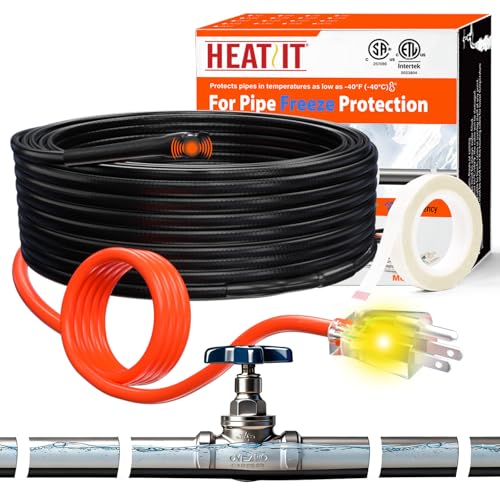
Designed for water-filled pipes, this HEATIT model combines CSA and ETL certifications, delivering reliable safety and performance across metal and plastic piping. It ships with a built-in thermostat, a 120V supply, and a 7W/ft rating. This product is best when an all-certifications approach is important, and when the user needs a heater with integrated thermostat control. Best for: households requiring dual certification and an integrated thermostat. Limitation: intended for water-filled pipes; not suitable for other fluids or fuel lines.
Cupohus Heat Tape for Water Pipes with Thermostat 3FT

The Cupohus 3-foot heat tape provides compact, easy-to-install protection for short pipe runs or tight spaces. It includes a 120V plug, a built-in thermostat, and a 59-inch cord length. It’s well-suited for hoses or small pipe segments that might freeze in winter weather. Best for: small-diameter pipes or limited spaces where a short, controlled heat tape is sufficient. Limitation: shorter length means coverage is limited for longer runs, so plan accordingly.
MAXKOSKO 6 Ft. Heating Cable for Pipe Freeze Protection

The MAXKOSKO option is a compact 6-foot self-regulating heating cable designed for smaller pipe segments. It features a 5W/ft output and includes a 3-foot power cord. The product emphasizes self-regulating technology to prevent overheating and conserve energy while protecting metal and plastic pipes down to -40°F. Best for: smaller pipelines, workshops, or remote cabins with shorter fry runs. Caution: ensure the length provides complete coverage without gaps, especially around bends or fittings.
Buying Guide
What to consider when choosing a pipe heating cable
- Pipe material: Most cables work with metal and plastic pipes; verify compatibility for your specific piping (copper, PVC, PEX).
- Coverage length: Match the product length to the total run of pipe needing protection. Longer runs require longer cables or multiple segments.
- Thermostat control: Integrated thermostats reduce energy use by turning heating on and off automatically based on temperature setpoints.
- Certifications: Look for full end-to-end certification (ETL, CSA) rather than plug-only certification for safer operation.
- Power requirements: Confirm voltage (usually 120V) and cord length; longer cords offer easier installation but may affect power usage.
- Installation flexibility: Some cables support straight, spiral, or overlapped installations. Ensure your layout can maintain consistent contact with the pipe.
- Safety features: Ground-fault protection, water-resistance jackets, and durable insulation improve reliability in outdoor environments.
How to install safely
- Plan a straight, non-overlapping run along the pipe, avoiding kinks or tight bends that could reduce heat transfer.
- Secure the cable using appropriate clips or tape designed for outdoor use to prevent movement in windy or snowy conditions.
- Use a GFCI outlet and ensure the power source remains dry and protected from the elements.
- Follow the manufacturer’s instructions for connection, thermostat settings, and recommended maximum temperatures.
Maintenance and long-term considerations
- Inspect yearly for wear, insulation damage, or exposed conductors after severe weather events.
- Replace damaged sections promptly; do not attempt to splice or repair heated cables with improvised materials.
- Store unused segments in a dry location to prevent moisture ingress and corrosion.
Comparison at a glance
- Best for long runs: HEATIT 40ft—extended coverage, strong safety credentials.
- Best value for mid-length runs: HEATIT 30ft—balanced coverage and efficiency.
- Best for small projects: Cupohus 3FT—compact, thermostat-controlled protection.
- Best for multi-scenario versatility: SZFY 3FT~200FT—wide length range for varied installations.
- Best for certified reliability: HEATIT with CSA & ETL and integral thermostat options.
FAQ
- Q: Do these cables work on plastic pipes? A: Yes, most listed products are designed for both metal and plastic pipes, including PVC and PEX.
- Q: Is an external thermostat necessary? A: Integrated thermostats are common and help save energy by turning the heat on/off automatically at set temperatures.
- Q: Can I install these outdoors? A: Yes, they are designed for outdoor use but ensure proper weatherproofing, secure mounting, and GFCI power protection.
- Q: Will a longer cable always be better? A: Not necessarily; longer cables cover more area but may require more planning to ensure even heating along the entire run.
- Q: Are these cables safe around electrical outlets and water exposure? A: Look for full certifications (ETL/CSA) and water-resistant jackets for better safety in wet outdoor environments.
- Q: How do I know what length to buy? A: Measure the total pipe length needing protection and add a safety margin for bends and fittings.