When you need hot water fast for camping, apartments without a full-size heater, or emergency use, portable and point-of-use heaters offer practical solutions. This guide highlights five reliable options, focusing on safety, efficiency, and ease of installation. Each product is evaluated for how well it fits temporary needs, from submersible immersion heaters to compact tankless and mini-tank models. Explore options designed to heat water quickly, with built-in safety features and user-friendly controls.
| Product | Type | Key Benefit | Approx. Use |
|---|---|---|---|
| Ornalry Immersion Water Heater | Immersion (Bucket) | Fast 1500W heating for up to 5 gallons | Buckets, home, camping |
| AMOZOK Immersion Water Heater | Immersion (Portable) | 1800W with real-time temp control | Buckets, tubs, pools |
| Bosch Tronic 3000 T ES2.5 | Mini-tank | 2.5 gallons near-sink hot water | Under-sink use |
| Thermomate 18 Gallon | Small tank | High-capacity point-of-use with adjustable temp | RV, kitchen/bath, cabins |
| EcoSmart ECO 11 | Tankless | On-demand hot water, compact | Small spaces, point-of-use |
Ornalry Immersion Water Heater

Type and use: Immersion heater designed for submersion in water-filled containers such as buckets or tubs. Power: 1500W high-power heating for rapid temperature rise. Capacity suitability: heats up to about 5 gallons of water. Safety features include a rust-resistant stainless steel guard and smart auto shut-off when the set temperature is reached. The unit includes a thermostat and an alarm to indicate target temperature. Operational note: ensure complete immersion for safe use to prevent fire hazards. Typical use cases include camping, home emergencies, or temporary hot water needs in RVs.
Performance and safety considerations: The device provides quick heating but requires careful handling around water and heating elements. The integrated temperature control reduces manual monitoring by turning the heater on or off to maintain the chosen setpoint. For best results, place fully under water and avoid exposing any portion to air during operation. While convenient for temporary setups, avoid extended use beyond safety guidelines.
AMOZOK Immersion Water Heater 1800W

Type and use: Immersion heater with adjustable thermostat for submersion in buckets, bathtubs, hot tubs, above-ground pools, or inflatable pools. Power: 1800W for rapid heating. Features: real-time temperature display, auto shutoff, and dry burn protection to prevent operation when water is low. The heavy-duty 14-gauge power cord provides durability. The unit is designed for daily utility in home and farm settings, including tents and garages. The thermostat maintains a stable temperature by pausing at the setpoint and reheating after a small drop.
Performance and safety considerations: The real-time temperature readout helps users reach the exact target quickly. Dry burn protection adds a safety layer, but never operate without water. Keep controller dry and above water line to ensure safe operation. Suitable for temporary or emergency hot water needs and flexible placement where power access is available.
Bosch Tronic 3000 T ES2.5 Mini-Tank
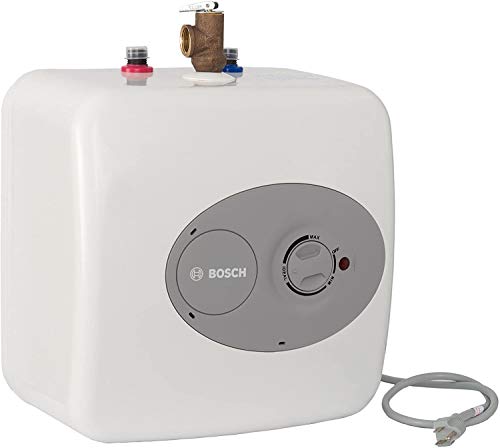
Type and use: 2.5-gallon point-of-use mini-tank designed to fit under a sink. Efficiency: high thermal efficiency at 98%. Installation: can be mounted shelf, wall, or floor with a 36–37 inch cord for flexible placement. Capacity is ideal for immediate hot water needs at a sink or small appliance setup. Electrical: 120V, 12A. Built for long service life with a glass-lined interior and compact dimensions (roughly 13.75 x 13.75 x 10.75 inches).
Performance and safety considerations: This unit provides reliable, on-demand hot water with quick recovery for small-scale uses. It is easy to install independently from a larger hot water source, useful for apartments, offices, or retrofits where only limited hot water is required. Space efficiency is a key advantage, though the limited 2.5-gallon capacity means it’s best for low- to moderate-demand scenarios.
Thermomate 18 Gallon Point of Use

Type and use: A larger point-of-use tank offering 18 gallons of hot water, suitable for sinks, dishwashing, washing machines, and showers. Temperature range: factory set to 125°F with adjustable range from 90°F to 150°F via internal thermostat. Profile: 25.5-inch compact design with 120V hard-wired installation, suitable for independent use or in-line booster with a larger hot water system. Heating element: INCOLOY-800 for better corrosion resistance and longer life. Applications include kitchens, bathrooms, RVs, cabins, garages, and more.
Performance and safety considerations: The 18-gallon capacity is a practical middle ground for moderate hot water demand in compact spaces. The INCOLOY-800 element improves longevity and energy efficiency at higher temperatures. Proper installation with appropriate clearances and electrical wiring is essential, especially when used in small or portable environments. The unit supports flexible placement while providing dependable hot water for routine tasks.
EcoSmart ECO 11 Tankless Electric

Type and use: 13 kW tankless electric model designed for on-demand hot water with patented self-modulating technology. Size: small footprint ideal for wall mounting or point-of-use installation. Performance: continuous hot water with temperature maintained within 1 degree of the set point. Efficiency: claims high thermal efficiency with no standby losses; only heats water when called. Amperage: 54A; requires appropriate electrical service and venting considerations for installation.
Performance and safety considerations: Tankless operation reduces energy waste and provides endless hot water at the point of use. Installation requires adequate electrical capacity and safe mounting. Temperature stability and response align with on-demand needs, but larger homes may require multiple units or higher-capacity models. This option is well-suited to tight spaces and those seeking continuous hot water without storing heated water.
Buying Guide
Key purchase considerations for temporary hot water solutions:
- Heat source type: Immersion heaters are portable and fast for small volumes but require submersion in water. Mini-tanks and tankless units provide more steady hot water for longer tasks but may need more installation effort and electrical capacity.
- Capacity vs. demand: For buckets or tubs, 1,000–1,800W immersion heaters work well. For sinks and short showers, 2.5–18 gallon options provide more sustained supply. Tankless models fit continuous use with high flow but require electrical readiness.
- Safety features: Look for automatic shut-off, dry burn protection, temperature control, alarms, and corrosion-resistant elements. Ensure proper immersion and water levels for immersion devices; verify that electrical hookups are grounded and compliant with local codes.
- Installation considerations: Point-of-use tanks are easier to install under sinks or in utility spaces. Tankless units require adequate electrical service (breaker size, wiring gauge) and proper venting or safe space for heat dissipation.
- Portability and durability: Stainless steel housings and rugged cords improve longevity for outdoor or travel use. Consider weather resistance and safety against accidental contact with heating elements.
- Energy efficiency: Tankless units generally offer energy efficiency due to on-demand heating. Immersion heaters may waste energy if left running without water; ensure automatic shut-off and monitoring features are functioning.
- Space and aesthetic fit: For small apartments or cabins, under-sink mini-tanks or compact tankless options save space. If you need heat in temporary setups (camping, emergency kits), portable immersion heaters are often the simplest choice.
Choosing the right temporary hot water solution depends on how much water you need, how quickly you need it, and the electrical or plumbing constraints of the space. Assess the typical usage scenario (bathing, dishwashing, or emergency heat) and match the product’s capacity, safety features, and installation requirements accordingly. This approach helps ensure reliable hot water with minimal complexity in temporary or limited-space environments.