Discover top wall-mount solar attic fans that combine solar power with smart features to improve attic ventilation, reduce heat buildup, and ease cooling loads on your HVAC system. Below are five strong options tailored for American homes, covering a range of sizes, power, and control styles. Use this guide to compare airflow, installation flexibility, and durability before choosing your next solar attic fan.
| Product | Airflow (CFM) | Panel Power (W) | Estimated Coverage | Key Feature |
|---|---|---|---|---|
| iLiving Hybrid Ready | 1150 | 40 | Up to 2900 sq ft | Smart thermostat control, adjustable solar panel |
| DC House 32W 1600CFM | 1600 | 32 | Multiple spaces (home, garage, shed) | Off-grid operation with sunrise activation |
| Hon&Guan 40W 2000 CFM | 2000 | 40 | Up to 2500 sq ft | Two operation modes with thermostat |
| Remington Solar 30W | Unknown listed | 30 | Attics and living spaces | Humidistat and thermostat, hybrid option |
| OmniPV Smart Hybrid Pro | 2850 | 50 | Up to 4000 sq ft | German tech, thermostat with wide range |
iLiving HYBRID Ready Smart Thermostat Solar Roof Attic Exhaust Fan

The iLiving unit combines solar-powered exhaust with a smart thermostat for temperature-based control. It includes an IP68 water-proof brushless motor designed for longevity and a 40-watt solar panel. The adjustable solar panel supports angles 0°, 15°, 30°, and 45°, enabling better solar capture in varying roof pitches. With a reported 1150 CFM output, it cools spaces up to roughly 2900 square feet, aiding attic ventilation and reducing HVAC load during hot days.
DC HOUSE Solar Attic Fan 32W 1600CFM
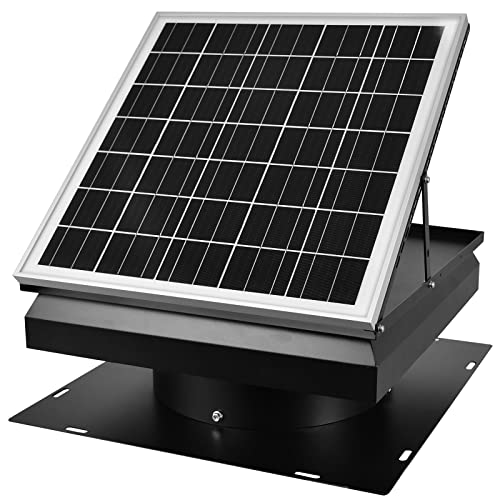
This 32-watt solar attic fan delivers up to 1600 CFM, offering off-grid operation with sunrise activation. It’s designed to harness free solar energy and eliminates wiring complexity while automatically cooling spaces as soon as sunlight is available. The unit supports pairing with existing vents for more comprehensive attic airflow, helping to lower attic temperatures and protect roofing materials from heat stress.
Hon&Guan Solar Attic Fan With Thermostat
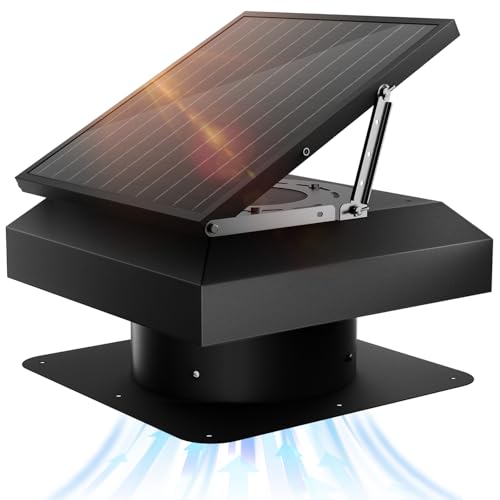
The Hon&Guan model provides up to 2000 CFM for cooling attics up to about 2500 square feet. It features two modes and a thermostat for automatic operation, plus an AC/DC adapter for continuous day-and-night use. Its multi-angle adjustment (0–70 degrees) helps optimize solar exposure for efficient operation, especially in shaded or partially sunny roof orientations. A practical choice for homeowners seeking consistent airflow without an electrical grid dependency.
Remington Solar 30 Watt Roof Mount

The Remington Solar option emphasizes energy savings by cooling attic spaces using solar power. It includes a humidistat and thermostat to adjust performance based on humidity and temperature, with a hybrid adapter available to operate at night. This design supports reducing moisture damage while lowering stress on HVAC systems during peak cooling periods. It’s positioned for homeowners seeking autotuned ventilation that adapts to day-night energy conditions.
OmniPV Smart Hybrid Solar Attic Exhaust Fan Pro

OmniPV’s Smart Hybrid Pro uses a 50W solar panel to deliver up to 2850 CFM, capable of cooling and dehumidifying up to 4000 square feet. It features a brushless DC motor and precise temperature controls, with continuous angle adjustments (-45° to +45° horizontally, 0° to 60° vertically) to maximize solar capture. The system is designed for large spaces and heavy-duty ventilation, with a focus on energy efficiency and flexible placement across different structures such as barns, garages, and greenhouses.
OmniPV Solar Attic Fan, 40 W, 1600 CFM

This OmniPV model emphasizes a low-noise, weatherproof build with a 40W solar panel and integrated thermostat. It provides up to 1600 CFM of airflow, suitable for larger rooms, attics, or workshops. The built-in thermostat helps automate operation to maintain comfortable ambient conditions while limiting energy usage on sunny days.
Buying Guide: Key Purchase Considerations
- Airflow vs. space: Match CFM to attic size and intended coverage. Bigger spaces benefit from higher CFM, but consider noise and power supply constraints.
- Solar panel power and efficiency: Higher wattage panels improve daytime performance but may require secure mounting. Look for monocrystalline cells and weatherproof housing for durability.
- Thermostat and control options: Automatic temperature-based activation can significantly reduce energy use. Some models offer multi-mode operation or remote control for convenience.
- Durability and weather resistance: Brushless DC motors, IP ratings, and corrosion-resistant housings extend life in harsh sun and humidity.
- Installation flexibility: Adjustable solar panels, tilt/angle settings, and horizontal/vertical mounting options affect performance and ease of installation.
- Energy independence vs. grid reliance: Off-grid operation is a major benefit of solar attic fans; consider if you want pure solar autonomy or hybrid options for night use.
- Maintenance needs: Look for simple access to components, filters, and seals. Routine checks help sustain performance over time.
- Noise levels: Most attic fans operate softly, but higher CFM units can produce noticeable sound. Check decibel ratings if you plan to mount near living spaces.
- Warranty and support: A long warranty signals confidence in durability. Confirm available customer support and replacement parts.
- Compatibility with existing ventilation: Some systems pair well with existing vents; others perform best as standalone exhaust units. Consider attic dimensions and roof structure.
When selecting a wall-mount solar attic fan, balance airflow needs with installation practicality and long-term costs. The products listed above cover a range of coverage areas, adjustable controls, and power options to help you identify a suitable solution for typical American homes, garages, and sheds.