Access to fluoride-reducing filtration is a priority for households aiming to lower fluoride intake from tap water while keeping great taste. The following five products represent diverse approaches—from under-sink ultrafiltration to countertop RO and pitcher-style filters—each designed to reduce fluoride and other contaminants. This guide highlights features, filtration depth, and practical considerations to help American homes choose a reliable fluoride-reducing system.
| Product | Filtration Type | Fluoride Reduction | Best For |
|---|---|---|---|
| Waterdrop WD-TSA-UF Under-Sink System | Under-sink 9-stage ultrafiltration | Yes (0.01 μm UF with fluoride reduction) | |
| Waterdrop 35-Cup Large Dispenser | Gravity/dispenser filtration | Over 90% fluoride reduction | Family use, fridge-ready |
| IceJoy 0.01 μm Gravity System | Under 0.01 μm UF gravity purifier | High fluoride reduction (up to 90%) | Countertop, no-plumbing solution |
| Bluevua RO100ROPOT-UV | Countertop RO with UV and remineralization | Reduces fluoride among other contaminants | Countertop RO with mineral balance |
| Reshape Water 10-Cup Pitcher | Pitcher with 6-stage filter | Reduces fluoride among others | Compact pitcher for quick filtering |
Note: Each product has trade-offs related to installation, filter costs, and water waste. The WD-TSA-UF is an under-sink setup ideal for replacing a faucet’s output, while the Waterdrop dispenser and IceJoy system offer gravity-filtered options that don’t require wiring or plumbing. The Bluevua RO unit provides remineralization, and the Reshape pitcher offers an affordable, space-saving alternative. Always verify compatibility with your faucet type and water source (municipal vs. well water).
Waterdrop 0.01μm Under-Sink Filtration

The Waterdrop WD-TSA-UF uses a 9-stage filtration stack designed to reduce chlorine, taste and odor, fluorides, heavy metals, rust, sediment, and particulates. Its 0.01 μm ultrafiltration element targets very small contaminants, while KDF components minimize heavy metals. It is intended for municipal cold-water sources with 1/2″ or 3/8″ female NPT connections. A notable note is that it does not reduce TDS. Filter replacements reference WD-10PP, WD-10GC, and WD-10UF compatible models. This system emphasizes a compact under-sink workflow for fluoride reduction without a countertop footprint.
Waterdrop 35-Cup Large Filter Dispenser
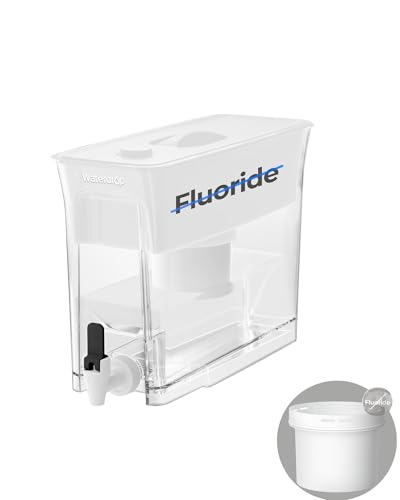
This large gravity-dispenser delivers significant fluoride reduction—advertised as greater than 90%—along with chlorine and other impurities. The upgraded carbon block improves taste and odor, providing cleaner, refreshed water in a 35-cup capacity. It is BPA-free and designed for family use; its non-electric operation makes it a simple countertop option, ideal for refrigerators or main kitchen consumption. While it reduces fluoride substantially, confirm cartridge availability and replacement costs for ongoing use.
IceJoy 0.01μm Gravity Filter System

The IceJoy system employs a 0.01 μm ultrafiltration membrane with a multi-layer filter stack that combines hollow fiber UF, silver-ion membranes, and activated carbon. It targets chlorine, PFAS, fluoride, heavy metals, microplastics, and bacteria, while preserving beneficial minerals. It does not reduce TDS, aligning with a philosophy of mineral retention. The design emphasizes high filtration precision (0.01 μm) and a compact countertop form with a spigot, suitable for family use without plumbing work. Fluoride reduction is a key feature when paired with the UF membrane.
Bluevua RO100ROPOT-UV Countertop RO
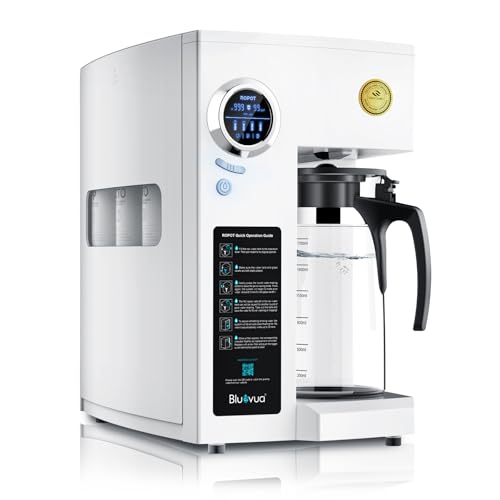
The Bluevua RO100ROPOT-UV provides six-stage filtration with a 0.0001 μm RO membrane, supplemented by UV sterilization and remineralization. It aims to reduce TDS, PFAS, fluoride, chlorine, arsenic, lead, and other contaminants while returning minerals to the water. As a countertop unit, it requires no plumbing and a power source for the UV and pump, with an emphasis on water-savings via a 2:1 pure-to-drain ratio. The included remineralization helps balance taste and mineral content post-filtration.
Reshape Water 10-Cup Pitcher

The Reshape Water pitcher features a 6-stage filter designed to reduce fluoride, chlorine, lead, and VOCs, while raising the water pH. The filters are advertised to cost less than many comparable pitchers, with a life expectancy of about 75 days or 300 liters per cartridge. The filtration media include FIR balls and ion-exchange resins, and the product emphasizes mineralization for a smoother taste. This option suits small households or as a quick fluoride-reduction solution without any installation.
Buying Guide: Key Considerations for Fluoride-Reducing Filtration
When choosing a fluoride-reducing filtration system, consider the following factors to match your needs and home setup.
- Filtration technology: Under-sink ultrafiltration offers thorough reduction of a broad range of contaminants but requires installation. Countertop RO provides strong contaminant removal and remineralization but needs space and power. Pitchers offer convenience and lower upfront costs but typically have higher ongoing filter costs and slower flow.
- Fluoride removal efficiency: Some systems claim “high” fluoride removal (over 90%), while others provide broad contaminant reduction. Compare membrane pore size (0.01 μm UF) and resin-based fluoride reduction to gauge effectiveness.
- Water source compatibility: Municipal water is the intended target for many of these systems. If you have well water, confirm that the unit is suitable and does not rely solely on municipal chemistry.
- TDS and minerals: Some filters lower total dissolved solids (TDS) or remove minerals. Decide whether you want to preserve minerals (which some systems do) or prioritize maximum contaminant removal with remineralization stages.
- Installation and maintenance: Under-sink filters generally require pluming and faucet compatibility; countertop units need power and space; pitchers are portable but require regular cartridge changes. Availability of replacement filters is an important ongoing cost.
- Waste and efficiency: RO systems can waste water in certain configurations. Look for 2:1 or better drain-to-pure water ratios and consider whether you’re willing to trade water efficiency for fuller contaminant removal.
- Certification and testing: NSF/ANSI or third-party testing helps verify claims. Check for independent testing on fluoride reduction and lead/PFC removal.
- Ease of use and capacity: If you’re sharing water across a family, larger capacities (35 cups or more) reduce frequent refills. For apartments or single households, compact pitchers or under-sink solutions may be ideal.
In sum, the best fluoride-reducing filtration choice depends on your kitchen layout, water source, and how much water you drink daily. Whether you prioritize under-sink filtration for a seamless setup or a countertop/ pitcher system for flexibility, there are fluoride-reducing options that balance taste, safety, and cost over time. Always verify compatibility, replacement filter availability, and any installation requirements before purchasing.